> For the complete documentation index, see [llms.txt](https://docs.stoik.io/llms.txt). Markdown versions of documentation pages are available by appending `.md` to page URLs; this page is available as [Markdown](https://docs.stoik.io/cyber-best-practices/nl/verhard-je-omgeving/email-authentication/what-is-dmarc-and-how-do-i-configure-it.md).
# Wat is DMARC en hoe configureer ik het?
## Definitie
DMARC (Domain-based Message Authentication, Reporting, and Conformance) is een protocol voor e-mailbeveiliging dat vertrouwt op SPF en DKIM om een domein te beschermen tegen spoofing- en phishingaanvallen.
Het stelt domeineigenaren in staat om:
* Een beleid te definiëren voor hoe niet-geauthenticeerde e-mails moeten worden afgehandeld (moeten ze worden geaccepteerd? in quarantaine geplaatst? geweigerd?).
* Rapporten te ontvangen over pogingen om hun domein frauduleus te gebruiken.
DMARC controleert specifiek of elke ontvangen e-mail door deze drie verschillende filters komt:
* SPF (het IP-adres van de afzender is geautoriseerd door het domein). Zie [Wat is SPF en hoe configureer ik het?](/cyber-best-practices/nl/verhard-je-omgeving/email-authentication/what-is-spf-and-how-do-i-configure-it.md)
* DKIM (de cryptografische handtekening van het bericht is geldig).
* Uitlijning (de domeinen die in SPF/DKIM worden gebruikt, komen overeen met het domein dat wordt weergegeven in het afzenderadres).
Als de e-mail niet door deze controles komt, past de ontvangende server het DMARC-beleid toe dat door het verzendende domein is gedefinieerd.
Hier is een voorbeeld van een DMARC-beleidsdefinitie: `_dmarc.yourdomain.com IN TXT "v=DMARC1; p=reject; rua=mailto:report@yourdomain.com"`.
* `v=DMARC1`: de DMARC-versie.
* `p=reject`: het toegepaste beleid. Hier betekent "reject" dat e-mails die niet door de drie hierboven genoemde filters komen, worden geweigerd, d.w\.z. niet in de mailbox worden ontvangen.
* `rua=mailto:...`: het adres voor het ontvangen van geaggregeerde rapporten.
## Configuratie
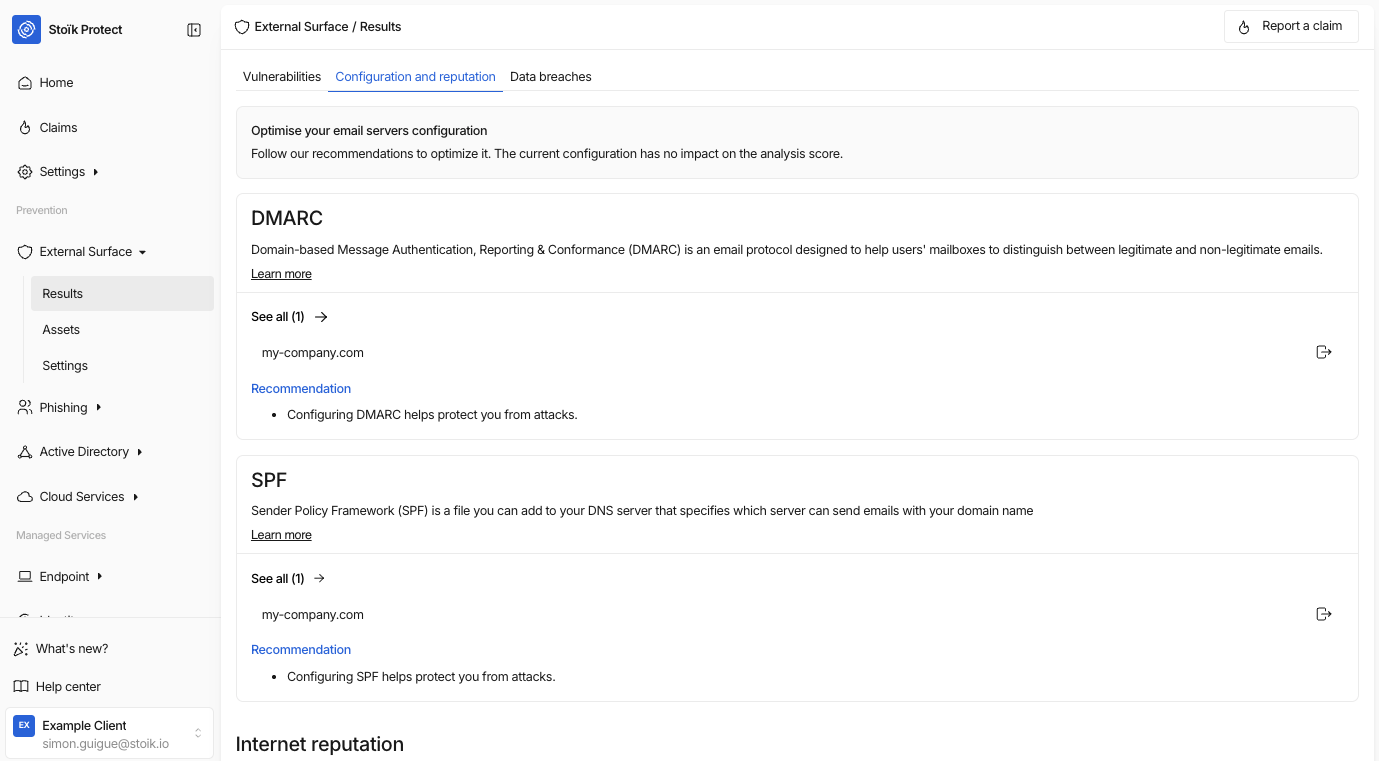
Ga naar `Externe scan` > `Resultaten` > `Configuratie en reputatie` om uw DMARC-gegevens te vinden.
Klik vervolgens op `Alles bekijken` onderaan de pagina: je vindt er verkeerd geconfigureerde domeinen, evenals installatiehandleidingen, afhankelijk van of je Google of Microsoft gebruikt.
{% hint style="info" %}
Stoïk beschouwt een DMARC-record als correct geconfigureerd wanneer het gekozen beleid "p=reject" of "p=quarantine" is.
{% endhint %}
Bovendien gebruikt de External Scan een cache die ongeveer 6 tot 7 dagen nodig heeft om bij te werken; daarom kan het zijn dat u tot een week moet wachten voordat de resultaten worden vernieuwd. Als alles in orde lijkt, maar het probleem aanhoudt, neem dan contact met ons op via .
---
# Agent Instructions
This documentation is published with GitBook. GitBook is the documentation platform designed so that both humans and AI agents can read, navigate, and reason over technical content effectively. Learn more at gitbook.com.
## Querying This Documentation
If you need additional information that is not directly available in this page, you can query the documentation by asking a question.
Perform an HTTP GET request on the following URL with the `ask` and `goal` query parameters:
```
GET https://docs.stoik.io/cyber-best-practices/nl/verhard-je-omgeving/email-authentication/what-is-dmarc-and-how-do-i-configure-it.md?ask=&goal=
```
`ask` is the immediate question: it should be specific, self-contained, and written in natural language.
`goal` is what the user is ultimately trying to achieve, the reason they need the answer. Sharing it helps GitBook give you a better, more relevant answer. A goal is most helpful when it describes the outcome the user wants rather than restating the question. For example, with `ask=how do I create an API token`, a goal like `automate deployments from our CI pipeline` lets GitBook tailor the answer to that use case.
The response will contain a direct answer to the question and relevant excerpts and sources from the documentation.
Use this mechanism when the answer is not explicitly present in the current page, you need clarification or additional context, or you want to retrieve related documentation sections.